
Use this article when setting up TenantTech for the first time or reviewing your company’s settings. It will guide you through configuring property management features to fit your business needs.
Before you begin, make sure you have received your Company Admin login credentials and can sign in to TenantTech. You should also review the available options with your team, as some selections may affect how your company uses the system. Once you are ready, follow the instructions to choose the settings that best fit your business processes.
These instructions focus on standard settings for Multifamily Northwest Forms, so settings for other forms may vary. If you have questions as you work through the article, contact Customer Support at support@tenanttech.com.
*Note: If your account has one property, you will see only the Account Settings option. Property Settings are only available for accounts with multiple properties. In a Multiple Property Account, changes made in Property Settings only apply to the selected property, while Account Settings apply to all the properties within that account.
Accessing Property Settings in a Multiple Property Account:
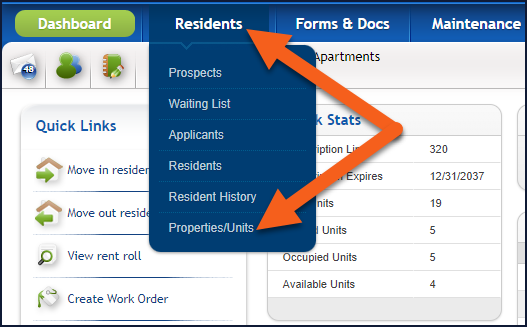
1. Go to Residents followed by Properties/Units.
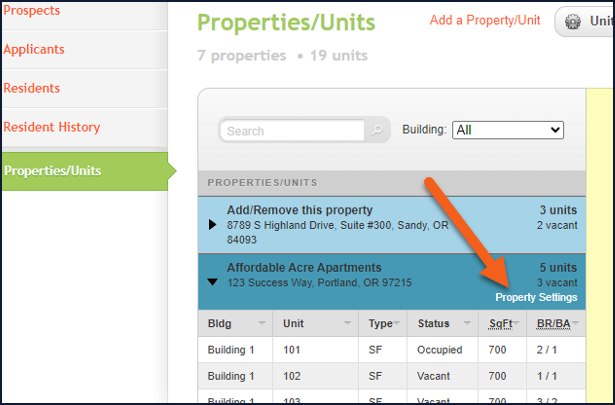
2. Select the appropriate property. Once selected, the property will be highlighted blue, and you can select the Property Settings hyperlink located to the right.
Now that you have accessed your Property Settings you can begin to manage the different settings found in the various setting categories (see below).
Property Settings
- Basic information
- Office
- Rental Agreement
- Owners
- Pets
- Safety & Structure
- Parking & Towing
- Application/Screening
- Area Information
- Miscellaneous
- Smoking Policy
- Reminders
- Order of Forms
- Lease Planning
- Prospects
- Cleaning & Repairs
- Inventory
- Depreciation
- Utilities
Basic Information:
Allows you to set the Property Name, Marketing Name, and address. Also allows you to select if the property (based on the property zip code) is within the limits of cities/counties that have special forms for their location, such as Portland, Oregon or Clark County, Washington. If this is not selected, then the property may not have access to city/county-specific forms that are needed.

Office:
You can enter the contact information for the property. The information set/saved here will appear on some reports & forms. If you will be using the same contact information for more than one property, then you may choose to select the box in the upper right, which allows you to select the other properties within your Multi-Property Account you will be applying it to.
*Note: When entering the phone number, only enter the ten-digit phone number. Fax numbers are the only exception and may include a 1 before the area code.

Rental Agreement:
This settings category contains many settings that can flow directly into your rental agreements. For this reason, we have broken each subsection into one of the bullet points below.
If you will be using all of the same rental agreement settings for more than one property, then you may choose to select the box in the upper right corner of the page, which allows you to select the other properties you will be applying it to.
- Execution Deposit: When an applicant is approved for a unit, they may have to pay an execution deposit. This setting determines if that execution deposit will be applied to the rent OR the security deposit and will be seen on the Execution Agreement document.

- Insurance: Use the radio buttons to select whether or not renters’ insurance is required for the property, then enter the minimum insurance amount the property requires.
- Real Estate License: This is only applicable for some Rental Agreements, based on your company's operations.
- Minimum and Maximum Lease Terms: Allows you to set restrictions on the minimum and maximum lease requirements, in terms of lease length.

- Special Lease Provisions: Allows you to add any default general special provisions for the property. When generating a Rental Agreement, these default provisions can then be inserted into the document by selecting the insert special provisions option that is made available to users.
- Special Garage Provisions: Allows you to add any provisions for garages within the property, such as, “Garages are to be used for vehicles only…” . The provisions entered here will flow into both the Resident Garage and Storage Agreement and the Non-Resident Garage and Storage Agreement forms.
- Other Occupants: Check this box, if you would like "None" to appear on the Rental Agreement where there are no minor occupants. Otherwise, it will remain blank on the agreement.
- Vehicles: Check this box, if you would like "None" to appear on the Rental Agreement when the residents do not have any vehicle information. Otherwise, it will remain blank on the agreement.
- Early Termination Provision: Check this box if the property will be charging a fee for early termination and be sure to provide the fee in the “Amount” field.
- Fees: Allows you to set fees for tampering with smoke/carbon monoxide detectors, as well as any HOA fees.
- Late Fees: You select if the late fees will be charged as a flat fee, a per-day fee, or 5% of the stated rent every 5 days.

- Rounding: Allows you to determine if the property will round their totals, and how they will be rounded, when applicable.

- Pro-Rated Month: Allows you to select which month of residency (first or second month) the prorated rent will be collected.

- Pro-Rate Formula: This setting determines the formula used to calculate pro-rated amounts for the property.

- Lease Term Calculation: This setting will determine when the property's lease terms expire.

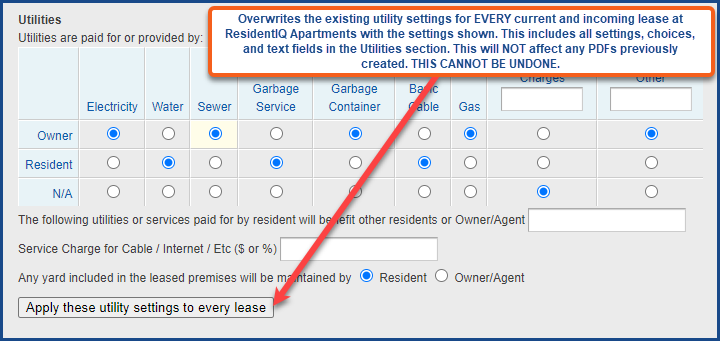
- Utilities:This allows you to select which utilities are the resident’s responsibility. This section may vary based on the state the unit is located in. For more information on on managing your Rental Agreement Settings, please see the following articles.

Owners:
This allows you to enter and save owner information. You are also able to choose who/what will show up on Forms and Notices. Use the radio buttons to determine if the owner’s name, the property management information, or a custom name/address will appear.
*Important Note: If you choose the option to use custom information, you MUST enter the custom information at the bottom of the page. Otherwise, the information will remain blank on the form/notice.

Pets:
Select whether or not the property will allow pets. If pets are allowed, then you can enter any additional Terms & Conditions related to pets. This information will appear on the Pet Agreement.

Safety & Structure:
This setting addresses lead-based paint and will flow to the Lead Base Paint Disclosure form.
Parking & Towing:
Allows you to determine how parking spaces are managed at the property (no parking, assigned parking, permit parking, etc.), monthly parking fees, and guest parking. Additionally, you may provide the towing company name and information. These settings and information will impact what is seen on the Parking Agreement.
Application/Screening:
This settings category contains many settings that can flow directly into your rental agreements. For this reason, we have broken each subsection into one of the bullet points below.
- Screening Company: Allows you to select the screening company the property uses.
- Income/Rent: Allows you to set a minimum income-to-rent ratio requirement for the property. *Not all properties have/use this setting option.
- Screening Charges: This is where you will set the property's screening charge and fee amount(s). It is important to know that the amounts entered here do not include the fee charged by the payment processor.

- Online App Holding Deposit: If you have this setting option, then it will allow you to select if the holding deposit should be charged through the online application. *Not all properties have/use this setting option.
- Application Status Change: If the box is checked, then a reason will be required when an applicant's status is manually changed.
- Rental Criteria & Additional Forms: This is where you select whether the property will use the state's default criteria or custom criteria. If using custom criteria, then you MUST upload the criteria. *Note: If the custom Criteria is deleted for any reason, the system will automatically default to the state criteria for the state where the property is located.
*Tip: If you are uploading the same rental criteria for every property, then you can set them all at once by going to Tools followed by Company Application/Criteria.
- Co-signer Application & Criteria: If you are at a property that uses the rent-to-income requirement, this setting allows you to set a minimum rent-to-income ratio requirement for co-signers.
*Note: When applying online, co-signers must select the option identifying themselves as a non-resident applicant. Otherwise, they will be given the typical resident application.
- Online Rental Application -- Welcome Screen: This allows you to choose between the default welcome message or creating your own custom welcome message to be displayed on the property's online application Welcome Screen.
- Online Application -- Deposits, Fees & Notes: This allows you to add notes that will be displayed to applicants on the left side of the Online Application page. For example, you could add a link to the property's website, add a note stating “Combined income must be 3 x rent or combined savings of 3 x 6 months’ rent", and so on.

- Online Rental Application -- Time to Rental or Deposit: Allows you to set a determinate amount of time (in hours) that an applicant will have, upon receiving their notification of approval, to either execute a rental agreement and make all deposits OR make a deposit to hold a unit and complete an agreement to execute a rental agreement.
- Online Rental Application -- Units: These settings will determine if an applicant will be required to select the unit they are applying for. In addition, you will be choosing settings that will determine how the units will be viewed by applicants when they are applying.

- Online Rental Application -- Invite Co-Applicants: If you would like the applicant to be able to invite another applicant to apply with them, then you will need to check this box.
- For more information about this feature, please review the article, Invite Co-Applicants Feature.
- Online Application -- Auto Email to New Applicant: Allows you to choose to use the default email message or create a custom email message that will be automatically sent to an applicant once they have initiated the application process.
Area Information:
This allows you to list what services/utilities serve the community where the property is located, as well as the service’s contact information. This information may be seen on the Utilities Set-up & Transfer Agreement document.

Miscellaneous:
Allows you to set integration codes and backend information for things like the property's time zone, mailbox numbers, electronic signatures for emails, etc.
- For more information related to mailbox numbers, please see the article Managing Mailbox Numbers.
- For the E-Signature email text, you can enter & save the default email message.

- When you have a document that is ready to be sent for signing, the saved/default message will automatically populate for you.

Smoking Policy:
The settings here will determine whether smoking is allowed anywhere on the property. If so, is smoking allowed anywhere or only in certain locations? These settings will impact what is seen on the Smoking Addendum document.

Reminders:
Allows you to set up property-level notifications specific to users.
*Note: This feature will work only if users have enabled reminders in their notification preferences. To access these settings, users can select their username at the top of the page, then select Notifications from the drop-down menu.

Order of Forms:
Allows you to customize the order that the forms will print for this property only.

Lease Planning:
Allows you to set limits on the number of leases that will be allowed to expire for each month in the year.

Prospects:
This is where you can enter & see the traffic sources used for the property (i.e., Local Newspaper, Rent.com, Zillow, etc.) that show up in Prospects >> Guest Card: traffic source.

Cleaning & Repair:
These settings allow you to determine what a resident will be responsible for paying for cleaning and/or repairs upon vacating. The information entered here will be seen on the Wear & Tear Addendum.

Inventory:
Allows you to add items that are in common areas of the property, such as a pool table in a game room, fitness equipment in the property fitness center, appliances in a property clubhouse, etc.

Depreciation:
Allows you to set the depreciation value for items relating to the Unit Inventory (typically used at move-in and move-out). If you are unsure how to create the Unit Inventory, please click here.

Utilities:
Allows you to select the appropriate utility options for the property and identify if there are any Flat Fees for the utilities. This information will impact what is viewed on the Utility Bill-Back Addendum, for the property. It does NOT impact what is presented in the "Utilities" section of the Rental Agreement. That information would need to be updated at Property Settings >> Rental Agreement (as noted above).
*NOTE: The Utilities section may vary based on the location of the units. For more information on utilities/Utility Bill-Back addendums please see the following articles.